Risk-based Management of Change
Criticality assessment, risk review, approvals, action tracking, and change history in one auditable record.
Configure replacement-in-kind rules, risk thresholds, and approval authority to your procedures and applicable requirements.
| Probability → | |||||
|---|---|---|---|---|---|
| Consequence ↓ | A | B | C | D | E |
| I | Risk classification 1, unmitigated example | Risk classification 1 | Risk classification 1 | Risk classification 2 | Risk classification 3 |
| II | Risk classification 1 | Risk classification 1 | Risk classification 2 | Risk classification 3 | Risk classification 4 |
| III | Risk classification 1 | Risk classification 2 | Risk classification 3 | Risk classification 4, mitigated example | Risk classification 4 |
| IV | Risk classification 2 | Risk classification 3 | Risk classification 4 | Risk classification 4 | Risk classification 4 |
| V | Risk classification 3 | Risk classification 4 | Risk classification 4 | Risk classification 4 | Risk classification 4 |
A–I · RC1: Centrifuge bearing failure—before mitigation.
D–III · RC4: Vibration monitoring and preventive maintenance applied.
Illustrative configuration only. Qualified reviewers must validate risk inputs, mitigations, and final classification for each change.
Observed in a Q2 2023 prototype
Historical observations from one implementation—not promised results.
- Execution improvement observed
- 32%
- Experienced-user completion observed
- ~30 min
- Redundant or failed projects identified
- 11
- Program effort reported saved
- 312 hrs
The approximately 30-minute observation applied to experienced users; higher-impact changes required longer review.
Every change carries risk.
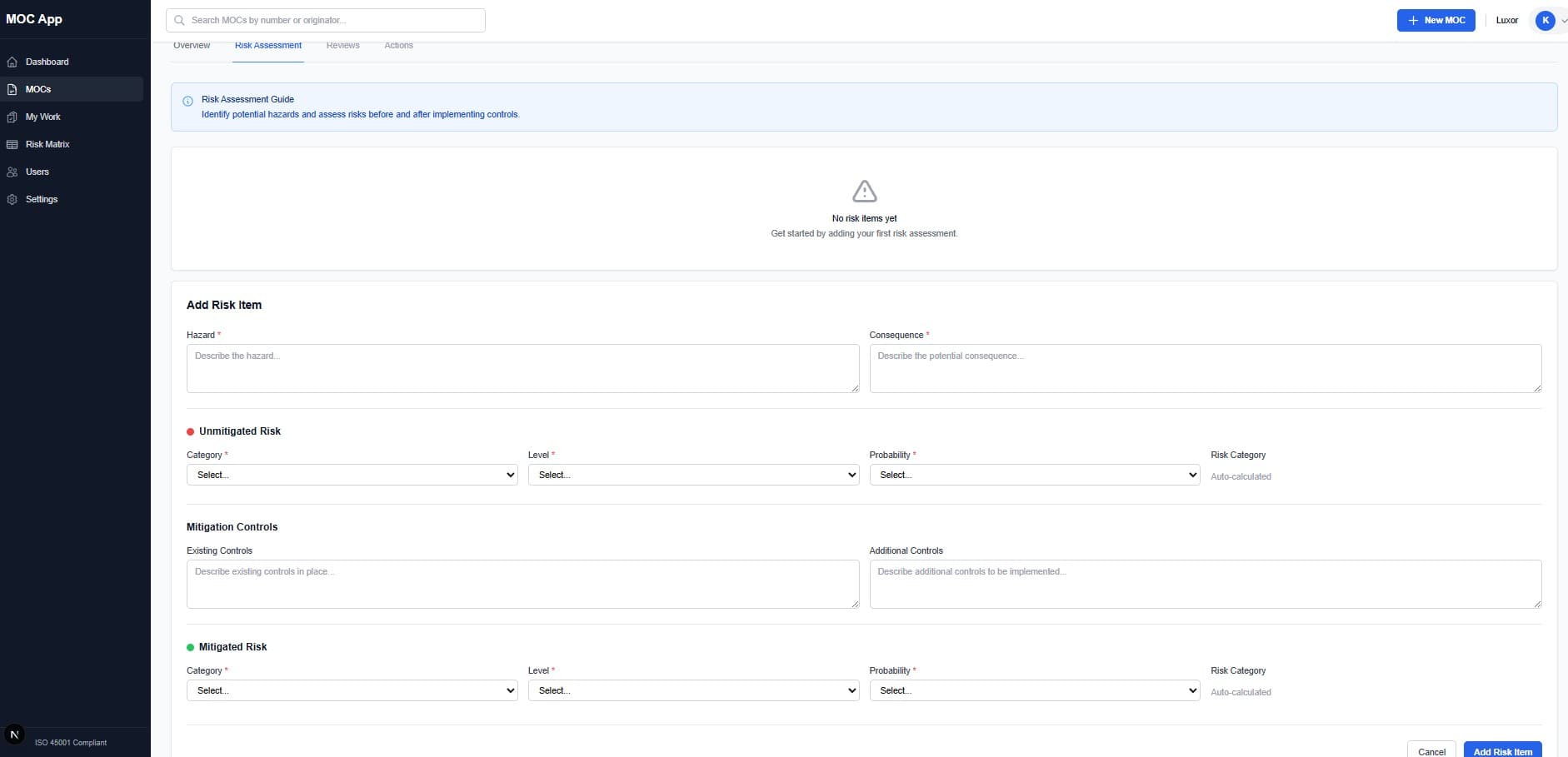
MOC routes every proposed change through Criticality Assessment → Risk Assessment → Stakeholder Review → Approval → Action Tracking in a single auditable record.
A completed MOC creates a structured record that can support due-diligence, audit, and incident-review needs. The record supports—but does not replace—your organization's approved procedures, competent review, or legal obligations.
The goal is simple: make the decision path visible, require the right people to review it, and retain the evidence behind the final approval.
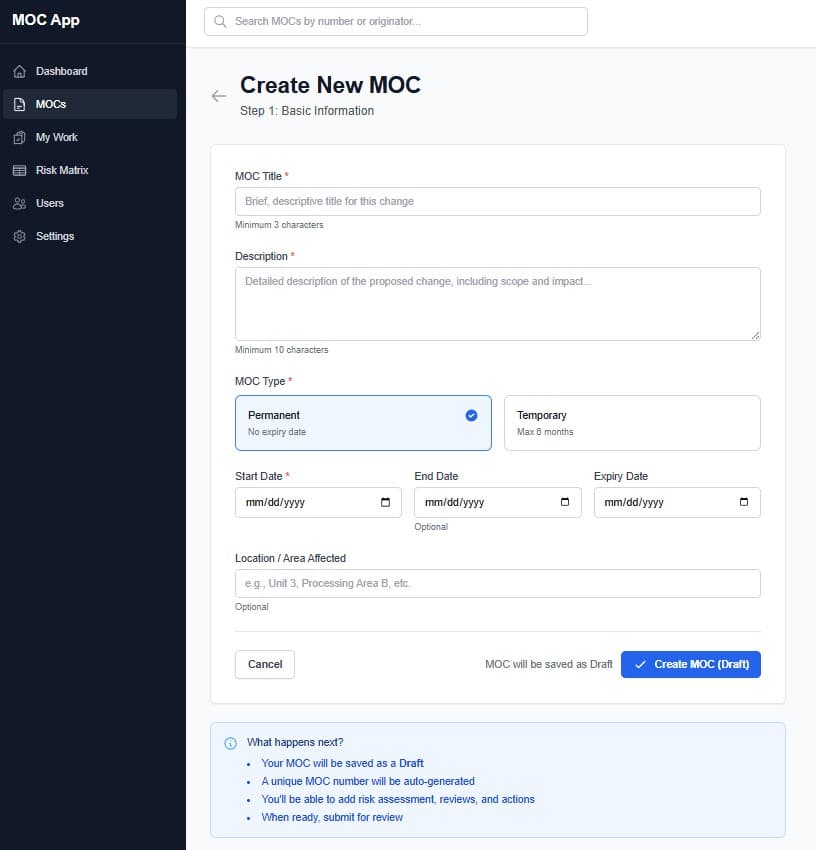
Configure around the requirements that apply.
These references inform configuration; they are not a certification or a blanket compliance claim. Your EHS, process-safety, and legal reviewers must confirm scope, thresholds, approvals, records, and retention for each site.
Process Safety Management
OSHA PSM includes Management of Change requirements for covered processes and excludes replacement-in-kind. Configure the workflow with qualified process-safety personnel for your applicable PSM elements.
OH&S Management Systems
A documented workflow can support an organization's control of planned changes under Clause 8.1.3 when it is configured within that organization's OH&S management system.
Risk Assessment Techniques
Risk-matrix scoring and Event Tree Analysis tools can support techniques described in ISO 31010. Qualified reviewers remain responsible for inputs, assumptions, and acceptance criteria.
Risk Management Framework
The configurable workflow can be mapped to identify → assess → treat → monitor practices. Your approved risk policy remains authoritative.
Risk Management Plan
For applicable RMP-covered processes, the workflow can support MOC records and review history. EHS and legal teams must validate applicability, configuration, and retention requirements.
Process Safety Guidelines
Internal procedures can be configured with reference to relevant CCPS guidance. The platform does not replace a site-specific process-safety program.
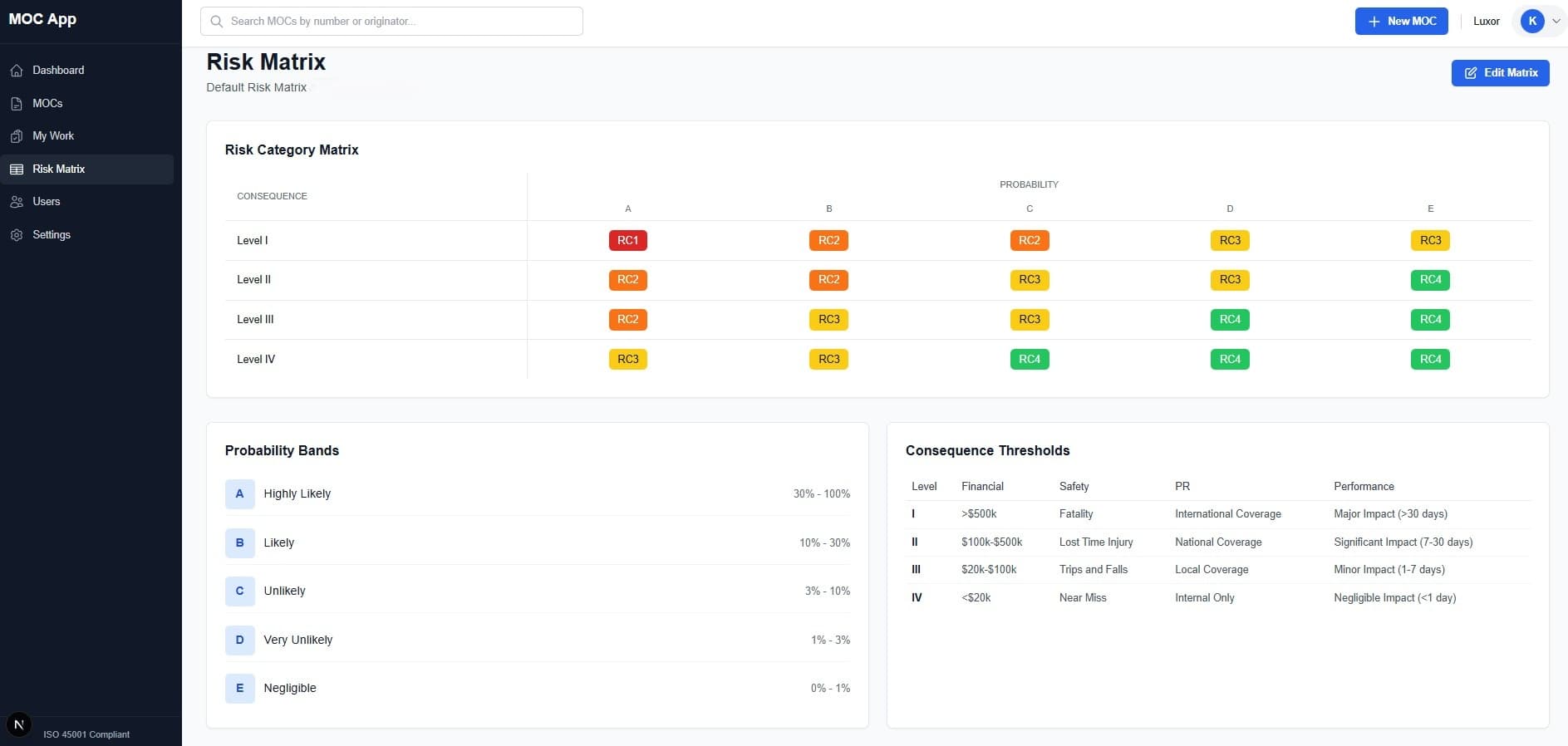
Use your approved consequence and probability thresholds.
Configure the matrix around your risk policy, including financial, safety, public impact, and performance dimensions. Qualified EHS and operational reviewers should approve the configuration before it is used for decisions.
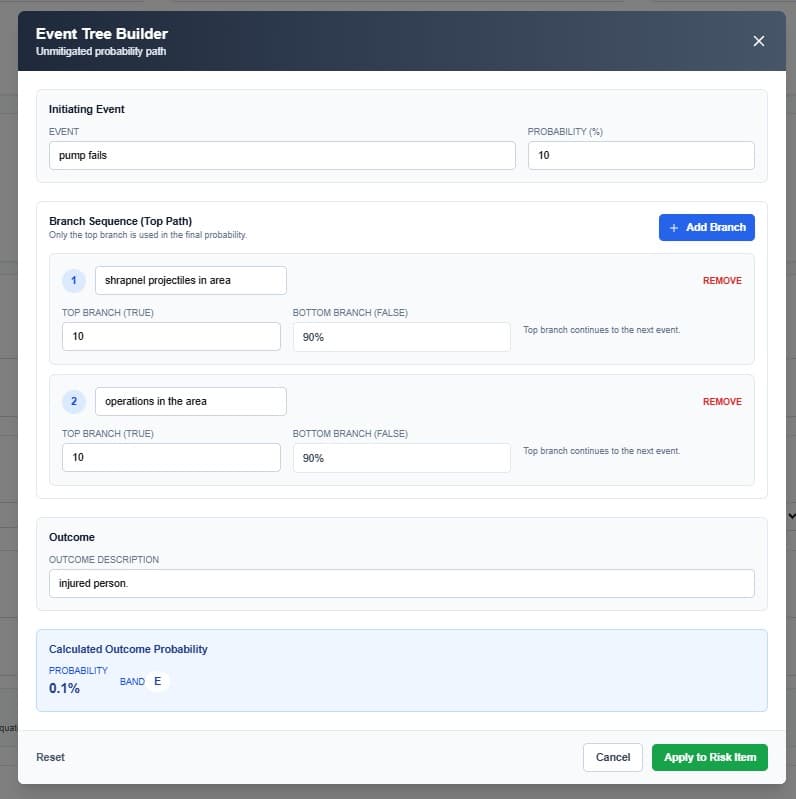
When probability is uncertain, build the tree.
Define the initiating event and branch sequences (true / false). The platform calculates compound probability from those inputs and presents the resulting RC band for qualified reviewer confirmation.
- —Initiating event + base probability
- —Sequential branch paths with true/false outcomes
- —Compound probability calculation across branches
- —Output → RC band presented for reviewer confirmation
End-to-end MOC workflow.
Configurable Yes/No logic helps determine impact scope and route the change to the required reviewers.
Hazard, consequence, and probability scored against configurable risk matrix — unmitigated to mitigated state tracked.
Define initiating events and branch sequences; the system calculates compound probability and presents the derived RC band for reviewer confirmation.
Configured stakeholders confirm review before the record becomes available to the approver.
An explicit, timestamped senior approval closes the review loop before authorized work proceeds.
Assigned, timestamped actions with owners and deadlines. Searchable by MOC number org-wide.
Unstructured change creates avoidable exposure.
No Documentation
Without a durable record, teams can repeat earlier failure modes and lose the reasoning behind past decisions.
No Stakeholder Awareness
Parallel work can proceed without the people who understand downstream impacts, constraints, or existing initiatives.
Unmitigated Operational Risk
Changes implemented without the required review can affect downstream operations without adequate notice or controls.
Safety & Legal Exposure
Incomplete review and approval records can increase safety, audit, and legal exposure when a change is challenged.
Review your MOC workflow with us.
Tell us about your current process, approval model, and applicable requirements. We'll tailor the walkthrough to your change environment.