MOC (Management of Change)
Compliant, risk-based
decision making.
ISO 45001 · ISO 31010 · OSHA PSM · EPA RMP. Every change — from a valve replacement to a full process redesign — tracked, risk-assessed, approved, and auditable.
32%
Project execution improvement
$477k
Cost avoidance per year
~30 min
Average MOC completion
11%
Redundant projects identified
Every change carries risk.
MOC routes every proposed change through Criticality Assessment → Risk Assessment → Stakeholder Review → Approval → Action Tracking in a single auditable record.
A completed MOC is proof of due diligence — the institutional record that answers every audit, legal, and safety question before it is asked.
Drawn from energy industry standards and the question that drives nuclear operations: “How do we ensure we make the right decision, every time?”
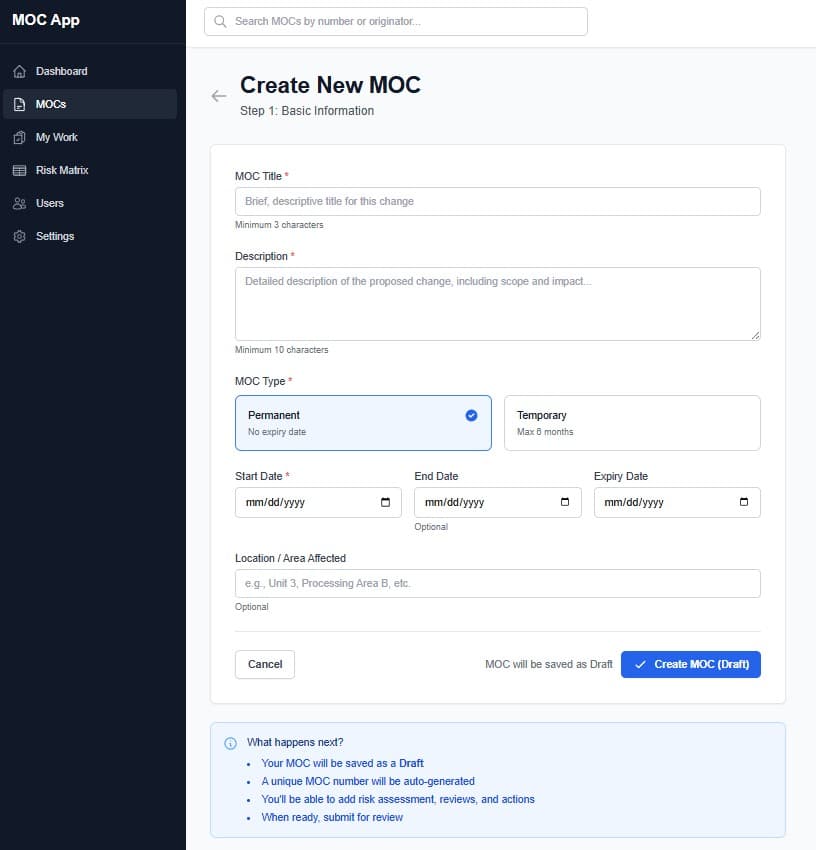
Built to the standards that matter.
Process Safety Management
PSM requires a documented MOC for every change except replacement-in-kind. Our platform satisfies every PSM element.
OH&S Management Systems
Clause 8.1.3 mandates control of changes affecting OH&S performance. MOC is the compliant mechanism.
Risk Assessment Techniques
Event Tree Analysis and risk matrix scoring built directly to ISO 31010 — quantified before any change proceeds.
Risk Management Framework
Identify → assess → treat → monitor. The platform's workflow maps to ISO 31000's universal risk process.
Risk Management Plan
RMP-covered processes require MOC procedures. Audit trail and records satisfy documentation obligations.
Process Safety Guidelines
Modelled on CCPS guidelines — the benchmark methodology for high-hazard industry change control.
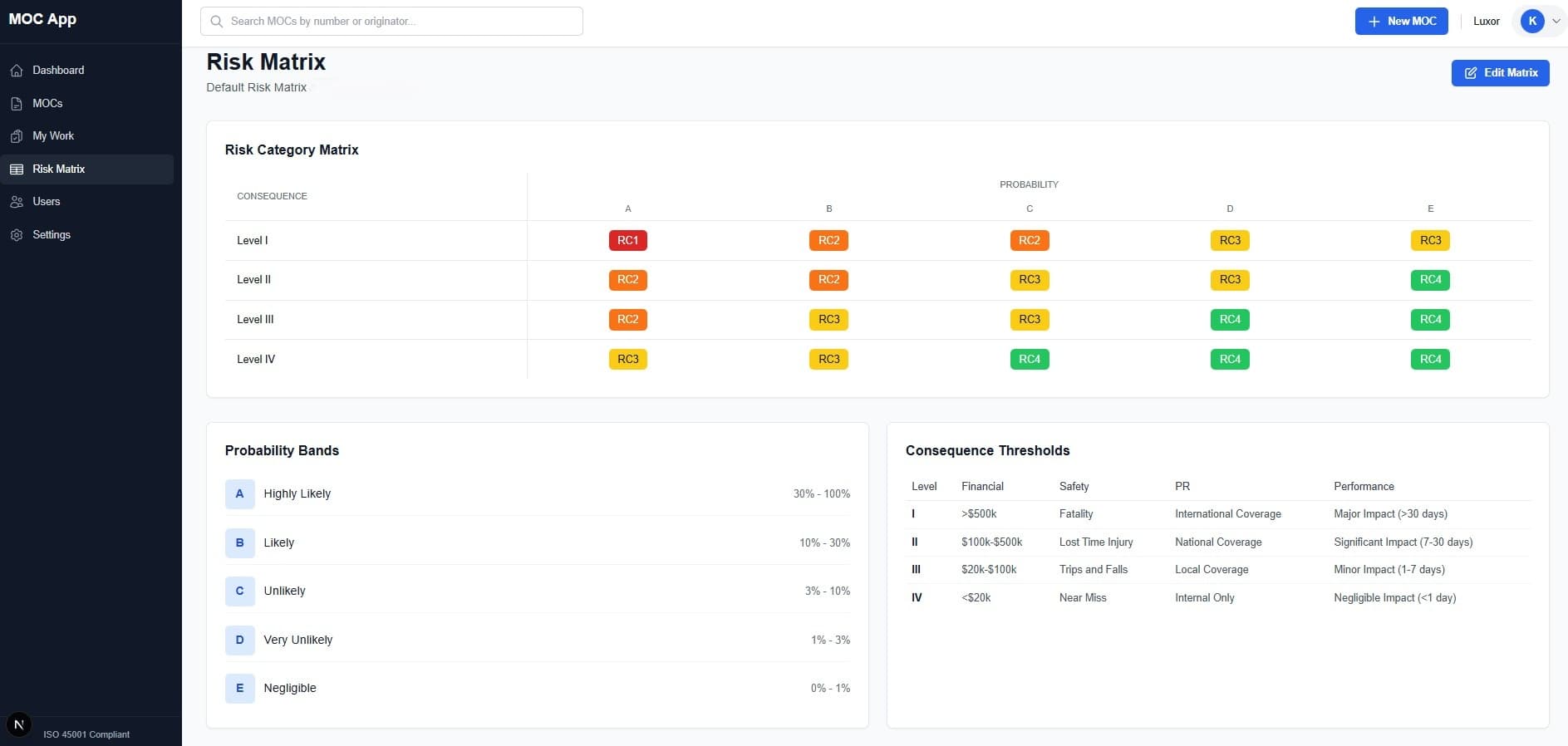
Set your own Consequence / Probability thresholds, or use industry standards.
Configurable risk matrix aligned to industry-standard frameworks. Consequence scored across financial, safety, PR, and performance dimensions.
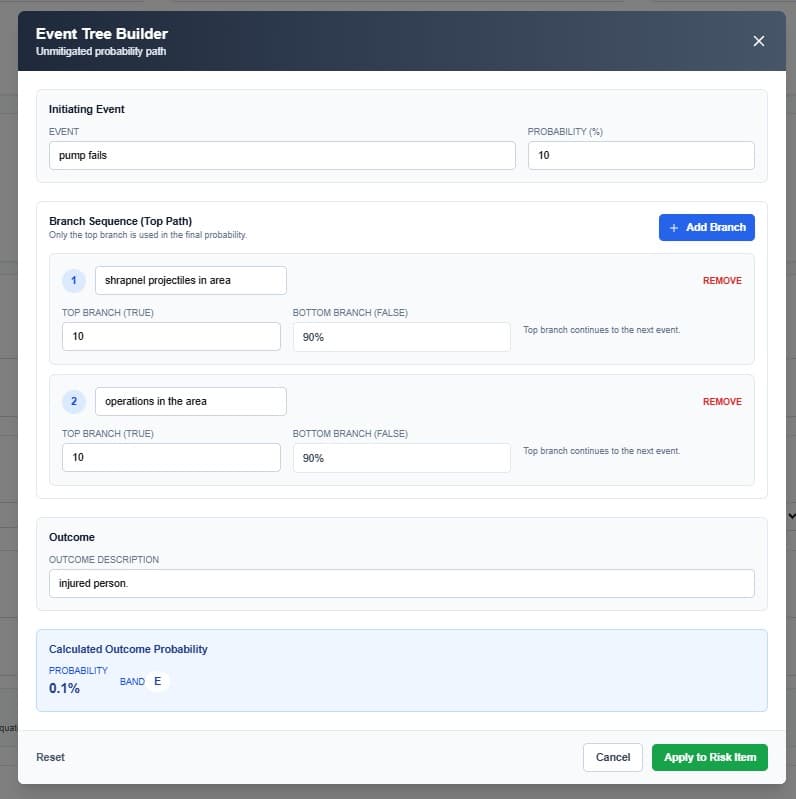
When probability is uncertain, build the tree.
Define the initiating event, build branch sequences (TRUE / FALSE), and the platform calculates compound probability — automatically applying the RC band to the risk item.
- —Initiating event + base probability
- —Sequential branch paths with true/false outcomes
- —Compound probability calculation across branches
- —Output → RC band, auto-applied to risk item
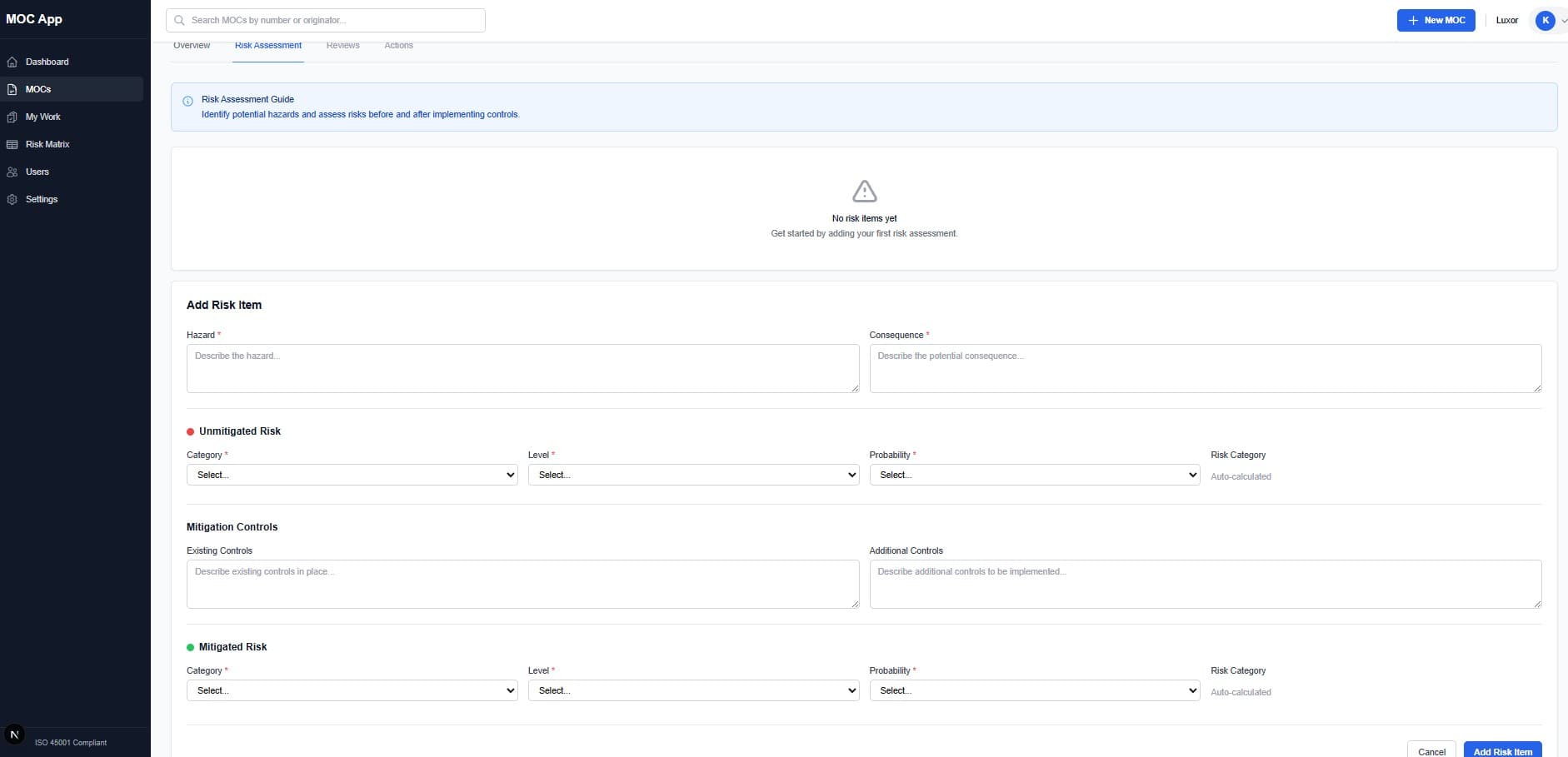
End-to-end MOC workflow.
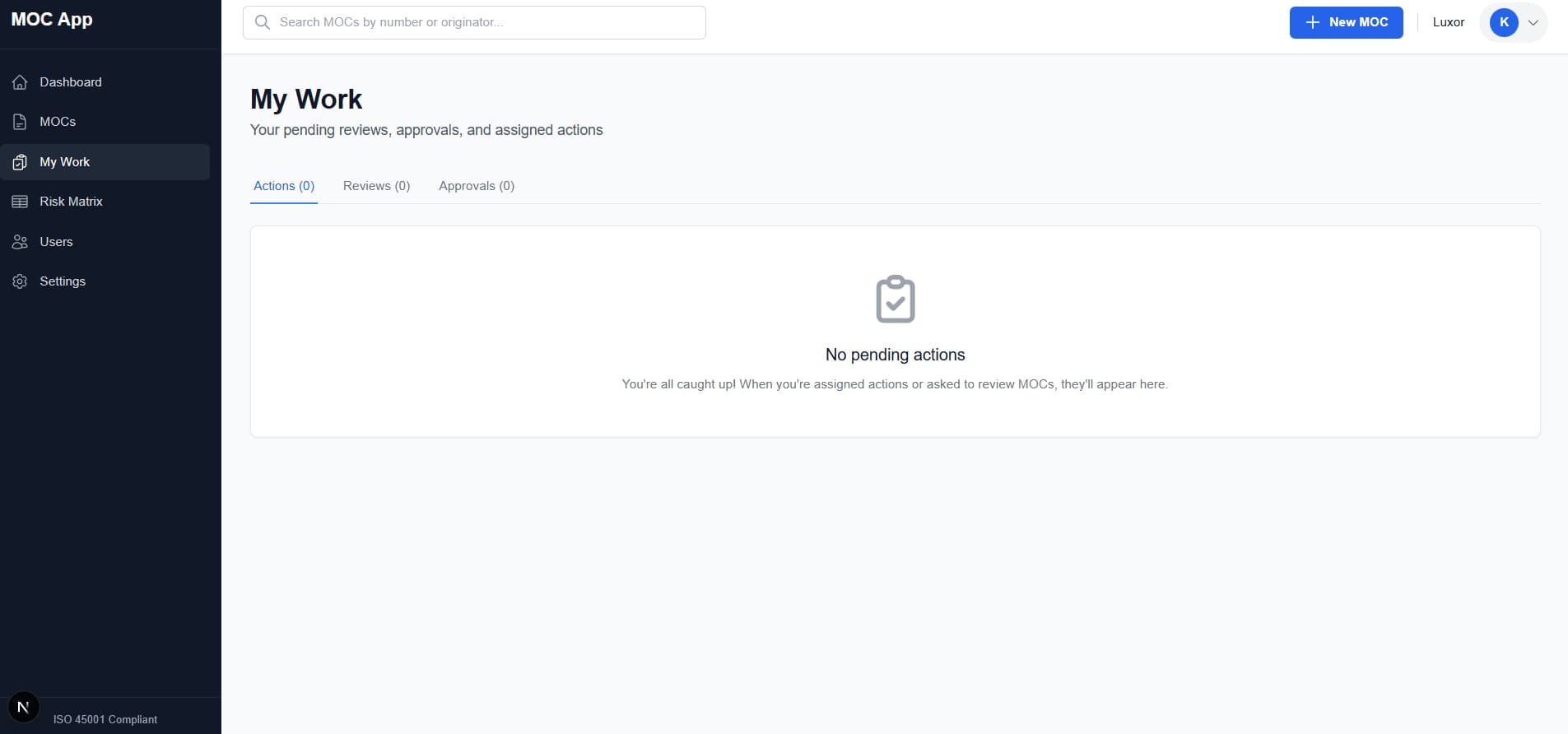
Structured Yes/No logic determines impact scope and escalates approval requirements automatically.
Hazard, consequence, and probability scored against configurable risk matrix — unmitigated to mitigated state tracked.
ISO 31010 Event Tree Analysis built in. Define initiating events, branch sequences — system calculates RC band.
All identified stakeholders must confirm review. Approver blocked until every reviewer signs off.
Single senior approver closes the loop. No change proceeds without explicit, timestamped sign-off.
Assigned, timestamped actions with owners and deadlines. Searchable by MOC number org-wide.
Non-standardized change management creates liability.
No Documentation
Without records, organizations repeat failures at the same regulatory constraints — years apart.
No Stakeholder Awareness
Teams run parallel projects unknowingly. Resources doubled or tripled for a single output.
Unmitigated Operational Risk
Changes implemented without approval impact downstream operations without notice or mitigation.
Legal & Safety Exposure
Inadequate approval produces safety violations and avoidable injury — with direct liability for the organization.
Request a Call or Demo
Tell us about your operations and we'll show you the platform in your change environment.